
pyku.analyse#
Analysis module
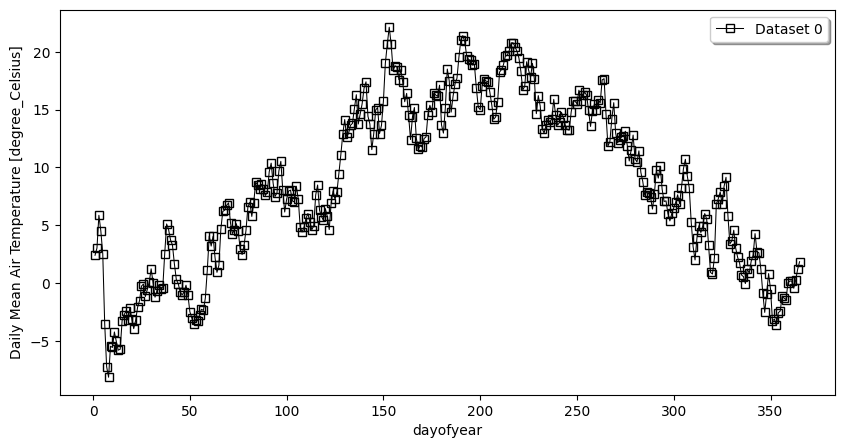
- pyku.analyse.daily_mean(*dats, var=None, ax=None, **kwargs)[source]#
Daily mean
- Parameters:
dats (
xarray.Dataset) – The input dataset(s)var (str) – The variable name.
**kwargs – Any argument that can be passed to
matplotlib.pyplot.figure()ormatplotlib.pyplot.axes(). In particularylim=(0,15),size_inches=(20, 40)), oryscale='log'can be passed.
Example
In [1]: %%time
   ...: import pyku
   ...: ds = pyku.resources.get_test_data('hyras_tas').compute()
   ...: ds.ana.daily_mean(var='tas')
   ...:
CPU times: user 1.4 s, sys: 206 ms, total: 1.6 s
Wall time: 1.35 s
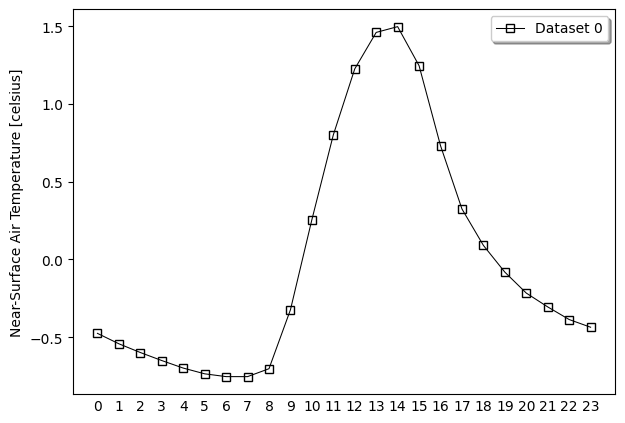
- pyku.analyse.diurnal_cycle(*dats, var=None, ax=None, **kwargs)[source]#
Diurnal cycle
- Parameters:
dats ([
xarray.Dataset, List[xarray.Dataset]]) – The input dataset(s)var (str) – The variable name.
**kwargs – Any argument that can be passed to
matplotlib.pyplot.figure()ormatplotlib.pyplot.axes(). In particularylim=(0,15),size_inches=(20, 40)), oryscale='log'can be passed.
Example
In [1]: %%time
   ...: import pyku
   ...: ds = pyku.resources.get_test_data('hourly-tas').compute()
   ...: ds.ana.diurnal_cycle(var='tas')
   ...:
CPU times: user 7.42 s, sys: 7.6 s, total: 15 s
Wall time: 14.4 s
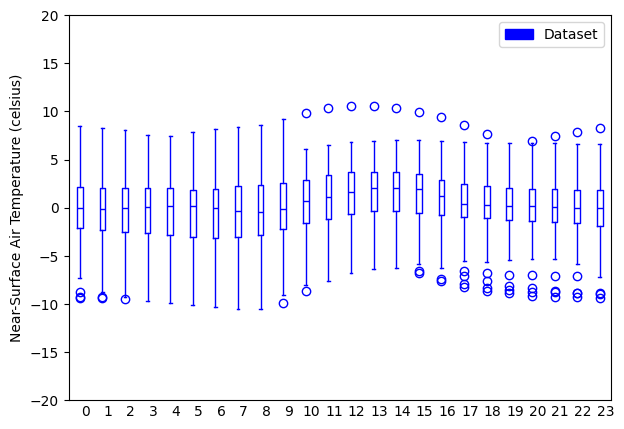
- pyku.analyse.diurnal_cycle_variability(dat1, dat2=None, var=None, ax=None, **kwargs)[source]#
Diurnal cycle variability
- Parameters:
dat1 (
xarray.Dataset) – The first dataset.dat2 (
xarray.Dataset) – Optional. The second dataset.var (str) – The variable name.
**kwargs – Any argument that can be passed to
matplotlib.pyplot.figure()or func:matplotlib.pyplot.axes. In particularylim=(0,15),size_inches=(20, 40)), oryscale='log'can be passed.
Example
In [1]: %%time
   ...: import pyku
   ...: ds = pyku.resources.get_test_data('hourly-tas')
   ...: ds.ana.diurnal_cycle_variability(var='tas', ylim=(-20, 20))
   ...:
CPU times: user 5.52 s, sys: 956 ms, total: 6.48 s
Wall time: 4.39 s
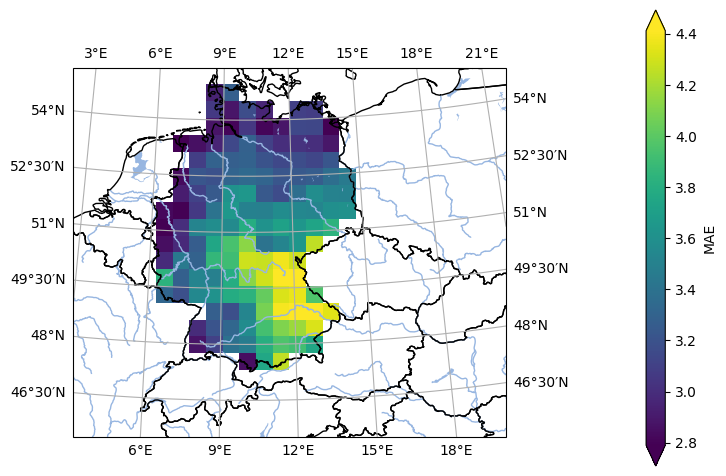
- pyku.analyse.mae_map(*dats, ref=None, var=None, crs=None, **kwargs)[source]#
Map of the mean absolute error.
- Parameters:
dats (
xarray.Dataset) – The input dataset(s).ref (
xarray.Dataset) – The reference dataset.var (str) – The variable name.
crs (
cartopy.crs.CRS) – The coordinate reference system.**kwargs – Any argument that can be passed to
matplotlib.pyplot.pcolormesh(),matplotlib.pyplot.axes()matplotlib.pyplot.figure(), orcartopy.mpl.gridliner.gridlines(). For example,cmap,vmin,vmax, orsize_inchescan be passed.
Notes
If an argument is passed which is not recognized, no error message is thrown and the argument is ignored.
Example
In [1]: %%time
   ...: import pyku
   ...:
   ...: # Open reference dataset and preprocess as needed
   ...: # -----------------------------------------------
   ...:
   ...: ref = pyku.resources.get_test_data('hyras')\
   ...:       .pyku.to_cmor_units()\
   ...:       .pyku.set_time_labels_from_time_bounds(how='lower')\
   ...:       .pyku.project('HYR-LAEA-50')\
   ...:       .sel(time='1981')\
   ...:       .compute()
   ...:
   ...: # Open model dataset and preprocess as needed
   ...: # -------------------------------------------
   ...:
   ...: ds = pyku.resources.get_test_data('model_data')\
   ...:      .pyku.project('HYR-LAEA-50')\
   ...:      .pyku.set_time_labels_from_time_bounds(how='lower')\
   ...:      .sel(time='1981')\
   ...:      .compute()
   ...:
   ...: # Calculate and plot
   ...: # ------------------
   ...:
   ...: ds.ana.mae_map(ref=ref, var='tas', crs='HYR-LAEA-5')
   ...:
CPU times: user 3.4 s, sys: 2.73 s, total: 6.14 s
Wall time: 6.04 s
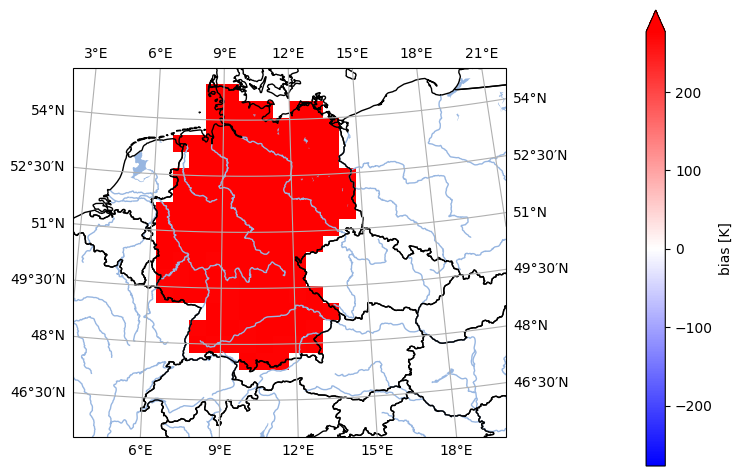
- pyku.analyse.mean_bias_map(*dats, ref, var=None, crs=None, **kwargs)[source]#
Map of the mean bias
- Parameters:
dats (
xarray.Dataset, List[xarray.Dataset]) – The input model dataset(s)ref (
xarray.Dataset) – The Reference/Observation datavar (str) – The variable name
crs (
cartopy.crs.CRS,pyresample.geometry.AreaDefinition, str) – Optional. The plot coordinate reference system.**kwargs – Any argument that can be passed to
matplotlib.pyplot.pcolormesh(),matplotlib.pyplot.axes()matplotlib.pyplot.figure(), orcartopy.mpl.gridliner.gridlines(). For example,cmap,vmin,vmax, orsize_inchescan be passed.
Notes
If an argument is passed which is not recognized, no error message is thrown and the argument is ignored.
Example
In [1]: %%time
   ...: import pyku
   ...:
   ...: # Open reference dataset and preprocess as needed
   ...: # -----------------------------------------------
   ...:
   ...: ref = pyku.resources.get_test_data('hyras')\
   ...:       .pyku.project('HYR-LAEA-50')\
   ...:       .sel(time='1981')\
   ...:       .compute()
   ...:
   ...: # Open model dataset and preprocess as needed
   ...: # -------------------------------------------
   ...:
   ...: ds = pyku.resources.get_test_data('model_data')\
   ...:      .pyku.project('HYR-LAEA-50')\
   ...:      .sel(time='1981')\
   ...:      .compute()
   ...:
   ...: # Calculate and plot
   ...: # ------------------
   ...:
   ...: ds.ana.mean_bias_map(dats=ds, ref=ref, var='tas', crs='HYR-LAEA-5')
   ...:
CPU times: user 908 ms, sys: 217 ms, total: 1.13 s
Wall time: 891 ms
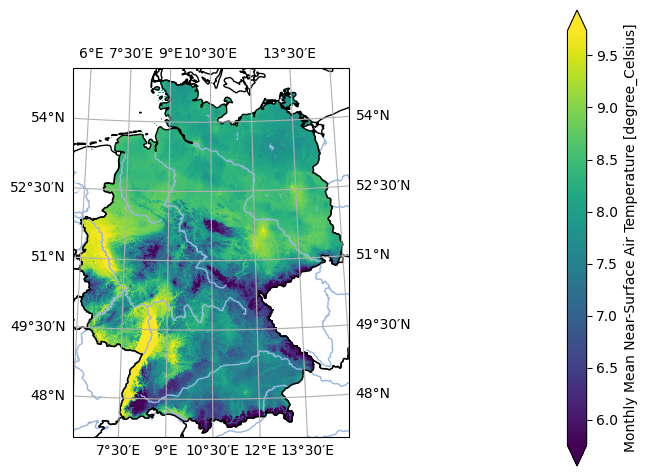
- pyku.analyse.mean_map(*dats, var=None, crs=None, same_datetimes=True, **kwargs)[source]#
Map of the mean
- Parameters:
dats (
xarray.Dataset, List[xarray.Dataset]) – The input dataset(s)var (str) – The variable name.
crs (
cartopy.crs.CRS,pyresample.geometry.AreaDefinition, str) – (Optional) Coordinate reference system of the plot.same_datetimes (bool) – (Optional) Defaults to
True. Select common datetimes between datasets.**kwargs – Any argument that can be passed to
matplotlib.pyplot.pcolormesh(),matplotlib.pyplot.axes()matplotlib.pyplot.figure(), orcartopy.mpl.gridliner.gridlines(). For example,cmap,vmin,vmax, orsize_inchescan be passed.
Example
In [1]: %%time
   ...: import pyku
   ...: ds = (
   ...:     pyku.resources.get_test_data('hyras-tas-monthly')
   ...:     .compute()
   ...: )
   ...: ds.ana.mean_map(var='tas', crs='HYR-LAEA-5')
   ...:
CPU times: user 21.1 s, sys: 7.86 s, total: 29 s
Wall time: 28.4 s
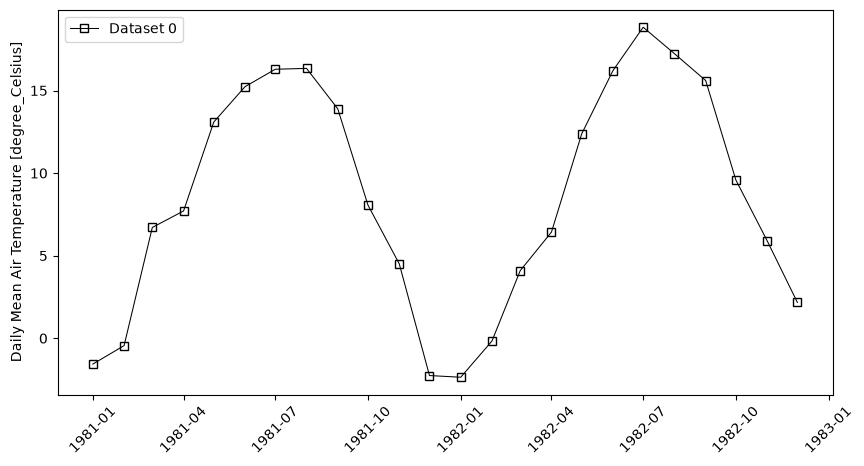
- pyku.analyse.mean_vs_time(*dats, var=None, time_resolution='1YS', ax=None, **kwargs)[source]#
Mean vs time
- Parameters:
*dats (
xarray.Dataset, List[xarray.Dataset]) – The input dataset(s).time_resolution (freqstr) – Time resolution (e.g. ‘1MS’ or ‘6D’)
var (str) – The variable name.
ax (
matplotlib.pyplot.axes) – Optional. Matplotlib pyplot axis.**kwargs – Any argument that can be passed to
matplotlib.pyplot.figure()ormatplotlib.pyplot.axes(). In particularylim=(0,15),size_inches=(20, 40)), oryscale='log'can be passed.
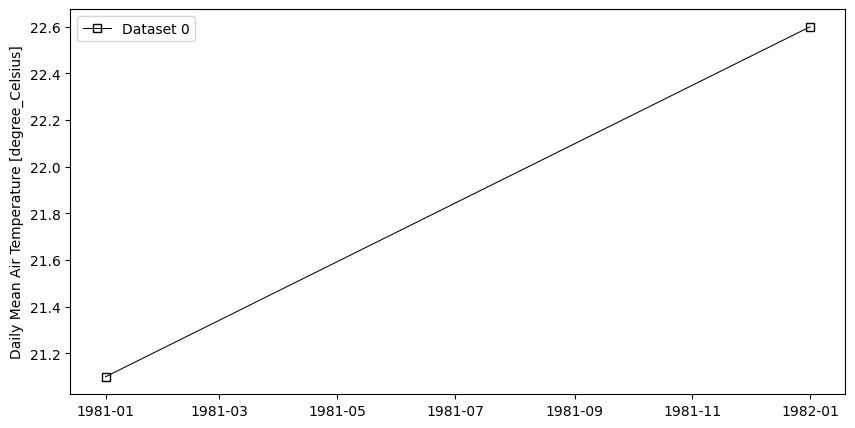
Example
In [1]: %%time
   ...: import pyku
   ...: ds = pyku.resources.get_test_data('hyras')
   ...: ds.ana.mean_vs_time(var='tas', time_resolution='1MS')
   ...:
CPU times: user 2.93 s, sys: 326 ms, total: 3.25 s
Wall time: 3.25 s
- pyku.analyse.metadata(ds_mod, ds_obs)[source]#
Report on metadata
- Parameters:
ds_mod (
xarray.Dataset) – Model dataset.ds_obs (
xarray.Dataset) – Reference dataset.
- Returns:
reStructuredText report
- Return type:
str
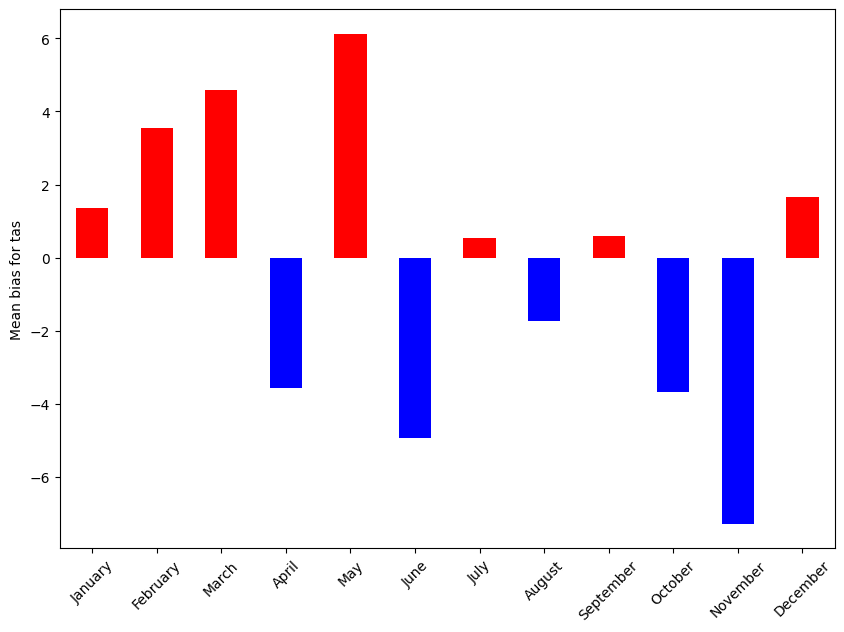
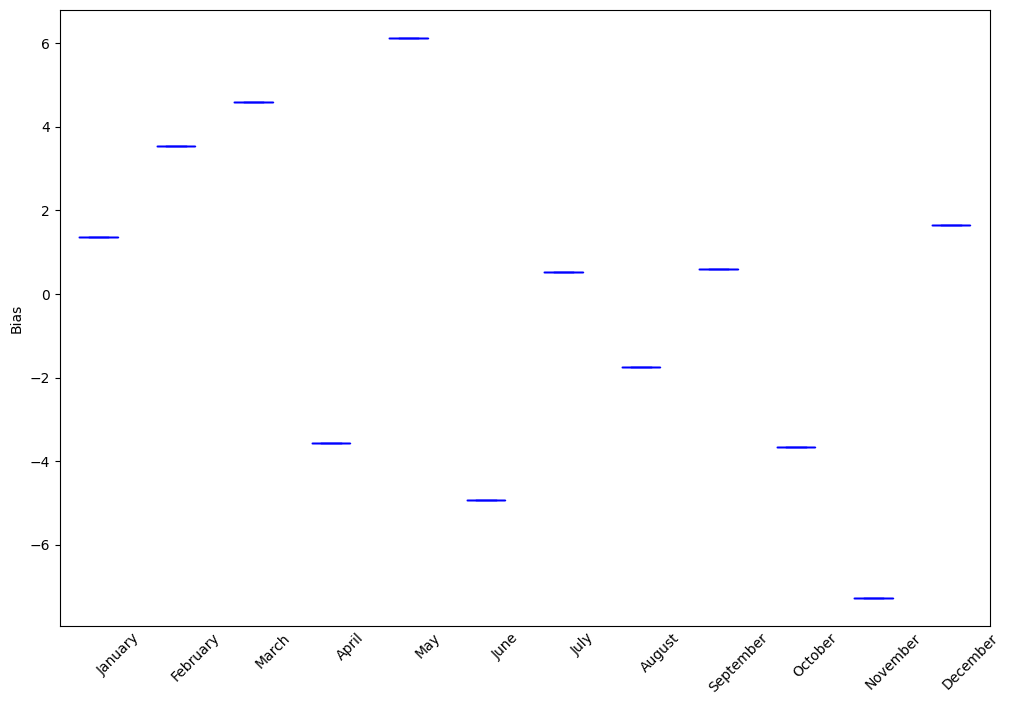
- pyku.analyse.monthly_bias(dat_mod, dat_obs, var=None, ax=None, **kwargs)[source]#
Monthly bias
- Parameters:
dat_mod (
xarray.Dataset) – The input dataset.dat_obs (
xarray.Dataset) – The reference dataset.var (str) – The variable name.
**kwargs – Any argument that can be passed to
matplotlib.pyplot.figure()ormatplotlib.pyplot.axes(). In particularylim=(0,15),size_inches=(20, 40)), oryscale='log'can be passed.
Example
In [1]: import pyku
   ...:
   ...: # Open reference data and preprocess as needed
   ...: # --------------------------------------------
   ...:
   ...: ref = pyku.resources.get_test_data('hyras')\
   ...:      .pyku.to_cmor_units()\
   ...:      .pyku.set_time_labels_from_time_bounds(how='lower')\
   ...:      .pyku.project('HYR-LAEA-50')\
   ...:      .sel(time='1981')\
   ...:      .compute()
   ...:
   ...: # Open model data and preprocess as needed
   ...: # ----------------------------------------
   ...:
   ...: ds = pyku.resources.get_test_data('model_data')\
   ...:      .pyku.project('HYR-LAEA-50')\
   ...:      .pyku.set_time_labels_from_time_bounds(how='lower')\
   ...:      .sel(time='1981')\
   ...:      .compute()
   ...:
   ...: # Calculate and plot
   ...: # ------------------
   ...:
   ...: ds.ana.monthly_bias(ref, var='tas')
   ...:
- pyku.analyse.monthly_bias_var(ds_mod, ds_obs, var, **kwargs)[source]#
Monthly bias variation
- Parameters:
ds_mod (
xarray.Dataset) – The input dataset.ds_obs (
xarray.Dataset) – The reference dataset.var (str) – The variable name.
crs (
cartopy.crs.CRS,pyresample.geometry.AreaDefinition) – (Optional) Coordinate reference system of the plot.**kwargs – Any argument that can be passed to
matplotlib.pyplot.figure()ormatplotlib.pyplot.axes(). In particularylim=(0,15),size_inches=(20, 40)), oryscale='log'can be passed.
Example
In [1]: %%time
   ...: import pyku
   ...:
   ...: # Open, reproject
   ...: # ---------------
   ...:
   ...: ref = pyku.resources.get_test_data('hyras')\
   ...:      .pyku.set_time_labels_from_time_bounds(how='lower')\
   ...:      .pyku.to_cmor_units()\
   ...:      .pyku.project('HYR-LAEA-50')\
   ...:      .sel(time='1981')
   ...:
   ...: # Open model, reproject, reset time labels, select the year
   ...: # ---------------------------------------------------------
   ...:
   ...: ds = pyku.resources.get_test_data('model_data')\
   ...:      .pyku.project('HYR-LAEA-50')\
   ...:      .pyku.set_time_labels_from_time_bounds(how='lower')\
   ...:      .sel(time='1981')
   ...:
   ...: # Calculate and plot
   ...: # ------------------
   ...:
   ...: ds.ana.monthly_bias_var(ref, var='tas')
   ...:
CPU times: user 1.72 s, sys: 517 ms, total: 2.24 s
Wall time: 1.58 s
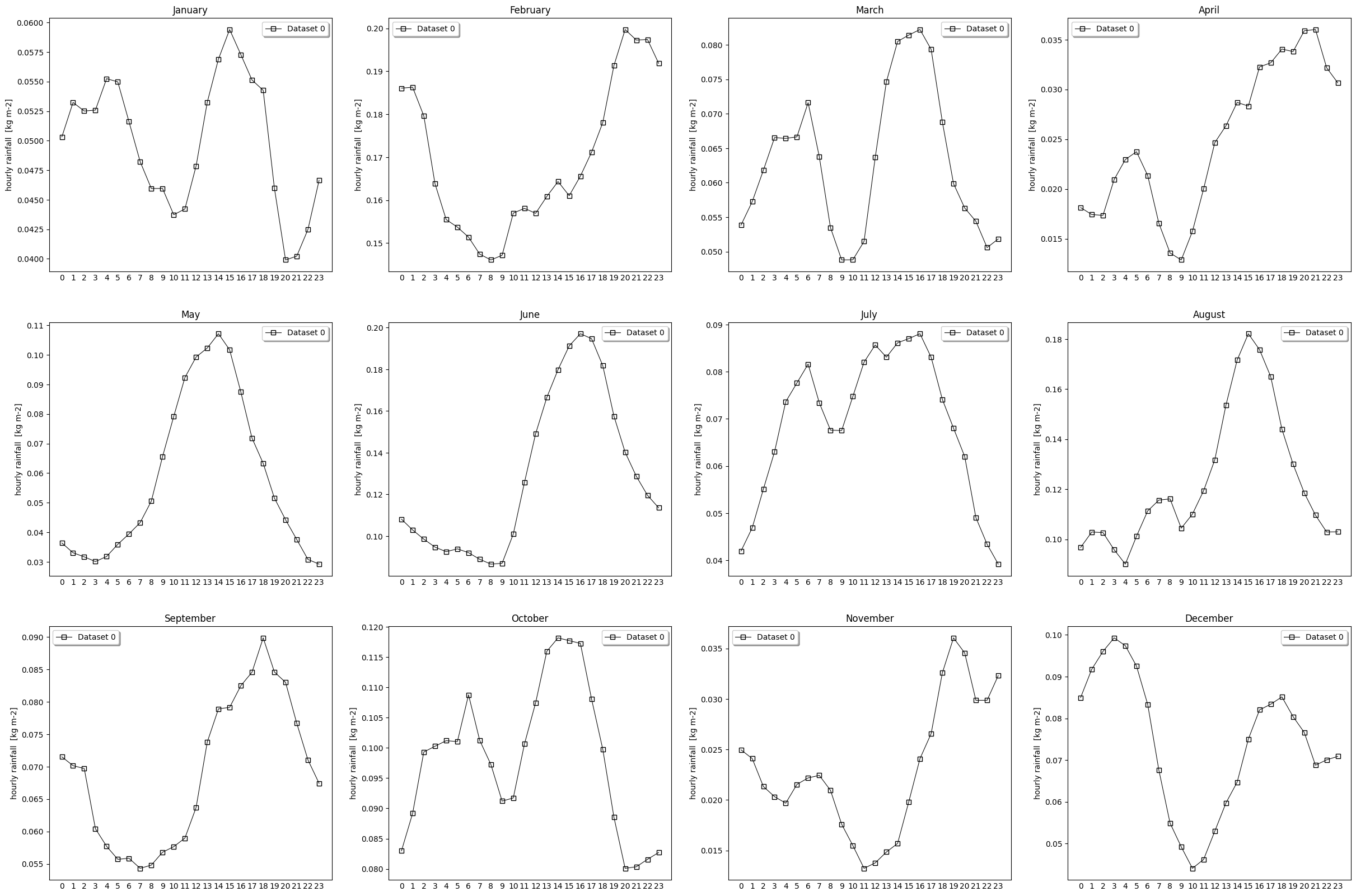
- pyku.analyse.monthly_diurnal_cycle(dat1, dat2=None, var=None, ax=None, **kwargs)[source]#
Diurnal cycle mean for each month
- Parameters:
ds_mod (
xarray.Dataset) – The input dataset.ds_obs (
xarray.Dataset) – Optional. The second dataset.var (str) – variable name
**kwargs – Any argument that can be passed to
matplotlib.pyplot.figure()ormatplotlib.pyplot.axes(). In particularylim=(0,15),size_inches=(20, 40)), oryscale='log'can be passed.
Example
In [1]: %%time
   ...: import pyku
   ...: ds = pyku.resources.get_test_data('low-res-hourly-tas-data')
   ...: ds = ds.compute()
   ...: ds.ana.monthly_diurnal_cycle(var='RR')
   ...:
CPU times: user 3min 21s, sys: 14.3 s, total: 3min 35s
Wall time: 2min 35s
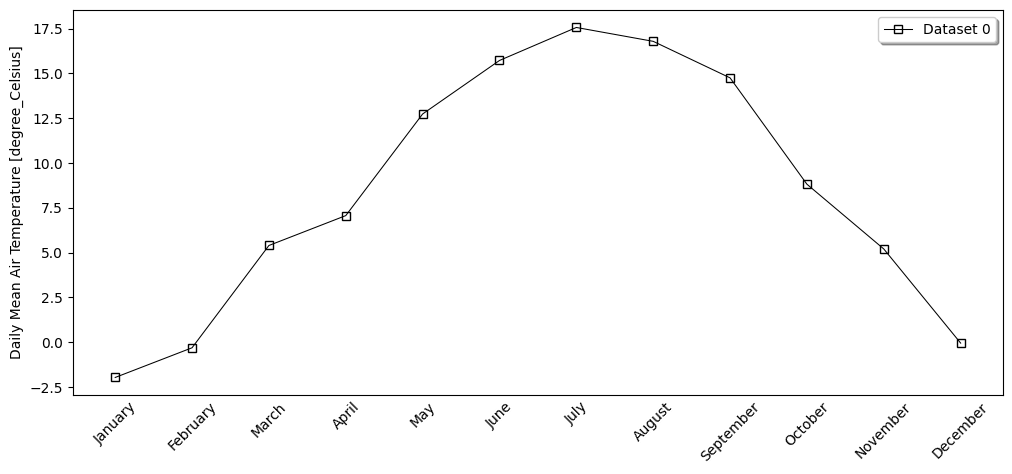
- pyku.analyse.monthly_mean(*dats, var=None, **kwargs)[source]#
Monthly mean
- Parameters:
dats (Union[
xarray.Dataset, List[xarray.Dataset]]) – The input dataset(s)var (str) – The variable name.
**kwargs – Any argument that can be passed to
matplotlib.pyplot.figure()ormatplotlib.pyplot.axes(). In particularylim=(0,15),size_inches=(20, 40)), oryscale='log'can be passed.
Example
In [1]: %%time
   ...: import pyku
   ...: ds = pyku.resources.get_test_data('hyras_tas')
   ...: ds.ana.monthly_mean(var='tas')
   ...:
CPU times: user 355 ms, sys: 194 ms, total: 549 ms
Wall time: 551 ms
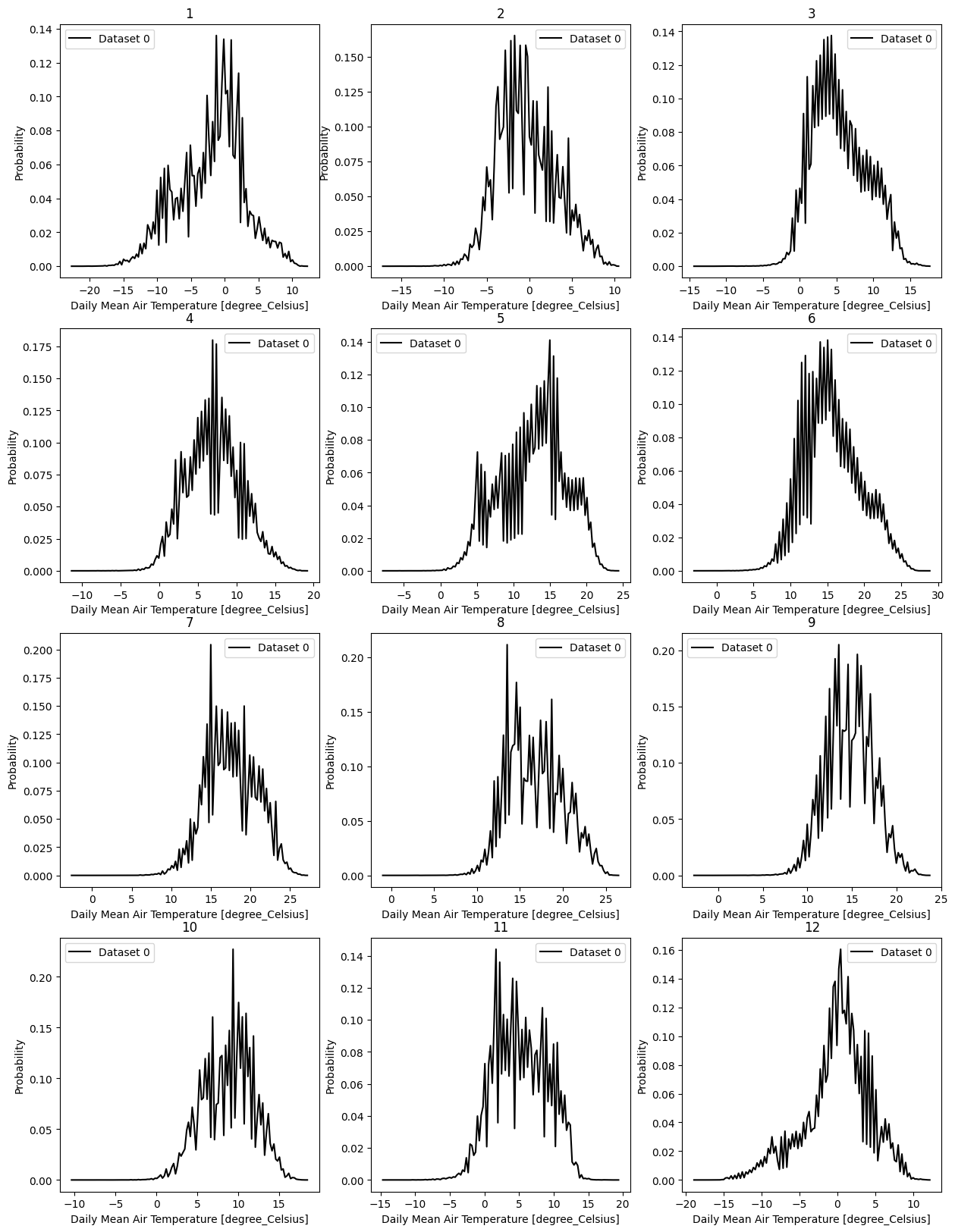
- pyku.analyse.monthly_pdf(*dats, var=None, **kwargs)[source]#
Probability distribution function for each season
- Parameters:
*dats (
xarray.Dataset, List[xarray.Dataset]) – The input dataset(s)var (str) – The variable name.
crs (
cartopy.crs.CRS,pyresample.geometry.AreaDefinition, str) – (Optional). The coordinate reference system of the plot.**kwargs – Any argument that can be passed to
matplotlib.pyplot.figure()ormatplotlib.pyplot.axes(). In particularylim=(0,15),size_inches=(20, 40)), oryscale='log'can be passed.
Example
In [1]: %%time
   ...: import pyku
   ...: ds = pyku.resources.get_test_data('hyras_tas').compute()
   ...: ds.ana.monthly_pdf(var='tas')
   ...:
CPU times: user 2.16 s, sys: 2.14 s, total: 4.3 s
Wall time: 4.33 s
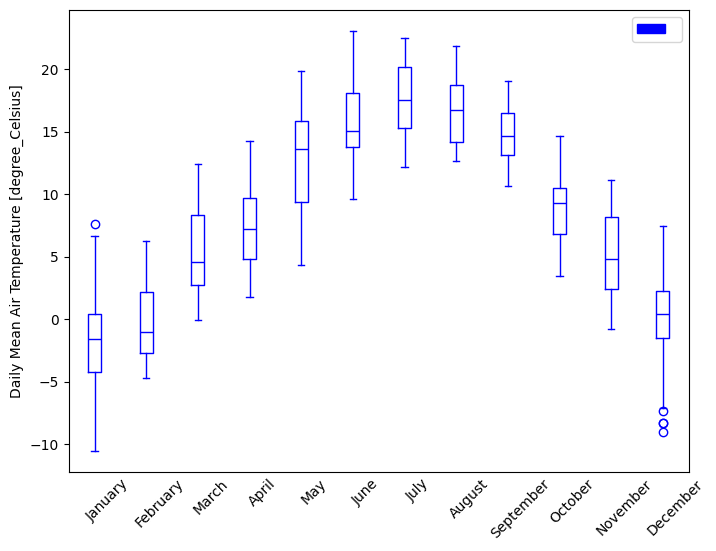
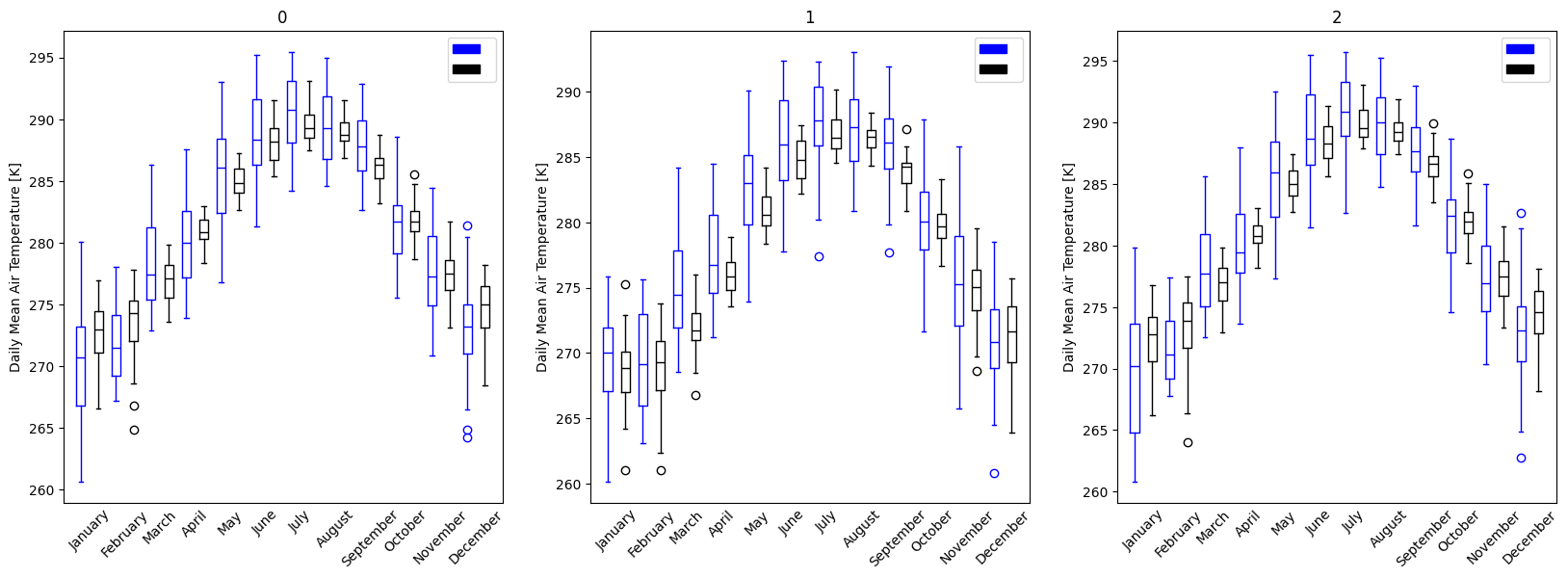
- pyku.analyse.monthly_variability(dat1, dat2=None, var=None, ax=None, **kwargs)[source]#
Monthly variability
- Parameters:
dat1 (
xarray.Dataset) – The first dataset.dat2 (
xarray.Dataset) – Optional. The second dataset.var (str) – The variable name.
**kwargs – Any argument that can be passed to
matplotlib.pyplot.figure()ormatplotlib.pyplot.axes(). In particularylim=(0,15),size_inches=(20, 40)), oryscale='log'can be passed.
Example
In [1]: import pyku
   ...: ds = pyku.resources.get_test_data('hyras_tas').compute()
   ...: ds.ana.monthly_variability(var='tas', size_inches=(8, 6))
   ...:
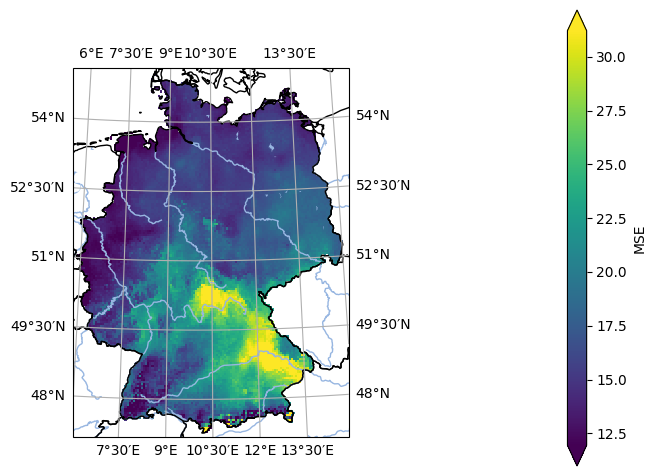
- pyku.analyse.mse_map(*dats, ref, var=None, ds_ref=None, crs=None, **kwargs)[source]#
Map of the Mean Squared Error (MSE)
- Parameters:
dats ([
xarray.Dataset, List[xarray.Dataset]) – The input dataset(s).ref (
xarray.Dataset) – The reference dataset.var (str) – The variable name.
crs (
cartopy.crs.CRS,pyresample.geometry.AreaDefinition, str) – Optional. The coordinate reference system of the plot.**kwargs – Any argument that can be passed to
matplotlib.pyplot.pcolormesh(),matplotlib.pyplot.axes()matplotlib.pyplot.figure(), orcartopy.mpl.gridliner.gridlines(). For example,cmap,vmin,vmax, orsize_inchescan be passed.
Example
In [1]: %%time
   ...: import pyku
   ...:
   ...: # Open reference dataset and preprocess as needed
   ...: # -----------------------------------------------
   ...:
   ...: ref = (
   ...:     pyku.resources.get_test_data('hyras')
   ...:     .pyku.to_cmor_units()
   ...:     .pyku.set_time_labels_from_time_bounds(how='lower')
   ...:     .pyku.project('HYR-GER-LAEA-5')
   ...:     .sel(time='1981')
   ...:     .compute()
   ...: )
   ...:
   ...: # Open model dataset and preprocess as needed
   ...: # -------------------------------------------
   ...:
   ...: ds = (
   ...:     pyku.resources.get_test_data('model_data')
   ...:     .pyku.project('HYR-GER-LAEA-5')
   ...:     .pyku.set_time_labels_from_time_bounds(how='lower')
   ...:     .sel(time='1981')
   ...:     .compute()
   ...: )
   ...:
   ...: # Calculate and plot
   ...: # ------------------
   ...:
   ...: ds.ana.mse_map(ref=ref, var='tas', crs='HYR-GER-LAEA-5')
   ...:
CPU times: user 1.23 s, sys: 515 ms, total: 1.75 s
Wall time: 1.5 s
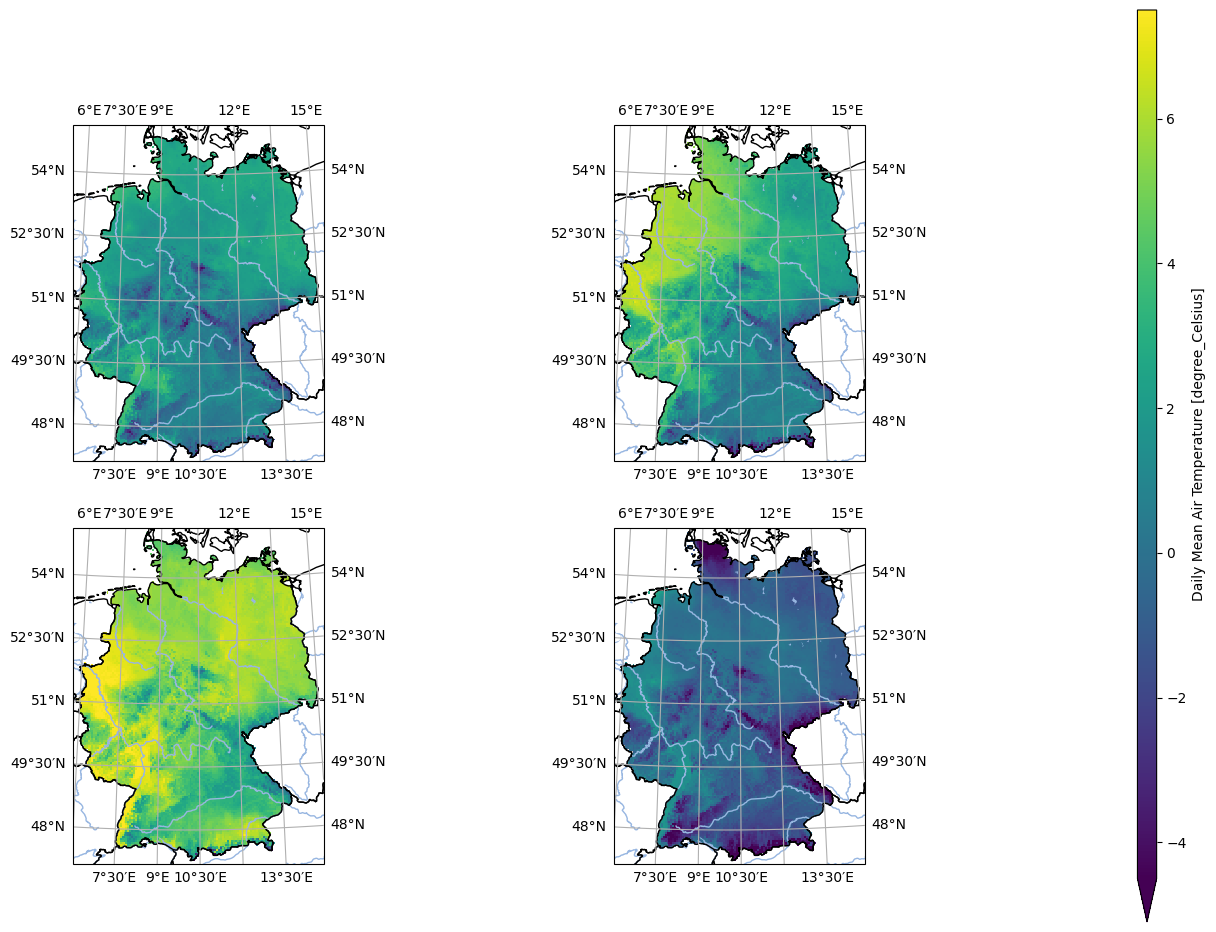
- pyku.analyse.n_maps(*dats, var=None, crs=None, colorbar=True, **kwargs)[source]#
Plot n maps side by side
- Parameters:
dats (
xarray.Dataset, or List[xarray.Dataset]) – The input dataset.var (str) – The variable name
crs (
cartopy.crs.CRS,pyresample.geometry.AreaDefinition, str) – (Optional) Coordinate reference system of the plot. If a string is passed, a pre-configured projection definition is taken from the configuration files (e.g. ‘EUR-44’, ‘HYR-LAEA-5’).colorbar (bool) – Optional. Defaults to
True. If set toFalse, the colorbar is not shown and the colormap of all plots is set independently.**kwargs – Any argument that can be passed to
matplotlib.pyplot.pcolormesh(),matplotlib.pyplot.axes()matplotlib.pyplot.figure(), orcartopy.mpl.gridliner.gridlines(). For example,cmap,vmin,vmax, orsize_inchescan be passed. Further options to control the layout:wspace(value for plt.subplots_adjust),
Example
In [1]: %%time
   ...: import pyku
   ...:
   ...: ds = (
   ...:     pyku.resources.get_test_data('small_tas_dataset')
   ...:     .compute()
   ...: )
   ...:
   ...: pyku.analyse.n_maps(
   ...:     ds.isel(time=0),
   ...:     ds.isel(time=1),
   ...:     ds.isel(time=2),
   ...:     ds.isel(time=3),
   ...:     nrows=2,
   ...:     ncols=2,
   ...:     var='tas',
   ...:     crs='HYR-GER-LAEA-5'
   ...: )
   ...:
CPU times: user 3.66 s, sys: 940 ms, total: 4.6 s
Wall time: 6.55 s
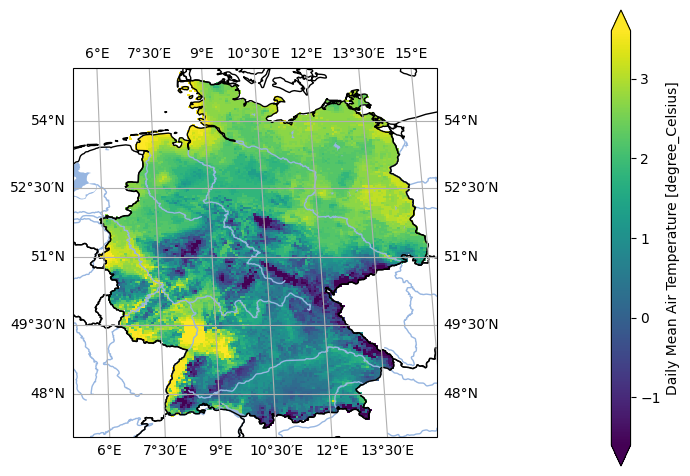
- pyku.analyse.one_map(dat, var=None, crs=None, **kwargs)[source]#
Plot one map
- Parameters:
dat (
xarray.Dataset) – The input dataset.var (str) – The name of the variable.
crs (Union[
cartopy.crs.CRS,pyresample.geometry.AreaDefinition, str]) – Coordinate reference system. A pyku pre-defined projection identifier can be passed with a string.**kwargs – Any argument that can be passed to
matplotlib.pyplot.pcolormesh(),matplotlib.pyplot.axes(),matplotlib.pyplot.figure(), orcartopy.mpl.geoaxes.GeoAxes.gridlines(). For example,cmap,vmin,vmax, orsize_inchescan be passed.
Example
In [1]: %%time
   ...: import pyku
   ...: ds = (
   ...:    pyku.resources.get_test_data('small_tas_dataset')
   ...:    .isel(time=0).compute()
   ...: )
   ...: ds.ana.one_map(var='tas', crs='seamless_world')
   ...:
CPU times: user 172 ms, sys: 71.4 ms, total: 243 ms
Wall time: 242 ms
- pyku.analyse.p98_map(*dats, var, crs=None, **kwargs)[source]#
Map of the 98th percentile
- Parameters:
*dats ([
xarray.Dataset, List[:class:`xarray.Dataset]]) – The input dataset(s)var (str) – The variable name.
crs (
cartopy.crs.CRS,pyresample.geometry.AreaDefinition, str) – Optional. The coordinate reference system of the plot.**kwargs – Any argument that can be passed to
matplotlib.pyplot.pcolormesh(),matplotlib.pyplot.axes()matplotlib.pyplot.figure(), orcartopy.mpl.gridliner.gridlines(). For example,cmap,vmin,vmax, orsize_inchescan be passed.
- pyku.analyse.p98_vs_time(*dats, var=None, time_resolution='1YS', ax=None, **kwargs)[source]#
98th percentile vs time
- Parameters:
*dats ([
xarray.Dataset, List[xarray.Dataset]]) – The input dataset(s).time_resolution (str) – The time resolution, e.g. ‘1MS’ or ‘6D’.
var (str) – The variable name.
( (ax) – class:matplotlib.pyplot.axes): Optional. Matplotlib pyplot axis.
**kwargs – Any argument that can be passed to
matplotlib.pyplot.figure()ormatplotlib.pyplot.axes(). In particularylim=(0,15),size_inches=(20, 40)), oryscale='log'can be passed.
Example
In [1]: %%time
   ...: import pyku
   ...: ds = pyku.resources.get_test_data('hyras_tas')
   ...: ds.ana.p98_vs_time(var='tas')
   ...:
CPU times: user 419 ms, sys: 137 ms, total: 556 ms
Wall time: 556 ms
- pyku.analyse.pcc_map(*dats, ref, var=None, crs=None, **kwargs)[source]#
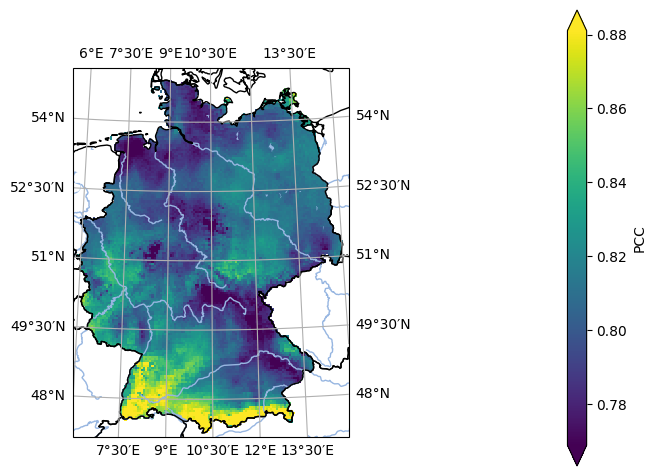
Map of the Pearson Correlation Coefficient (PCC)
- Parameters:
dats ([
xarray.Dataset, List[xarray.Datasets]]) – The input dataset(s)ref (
xarray.Dataset) – The reference dataset.var (str) – Variable name
crs (
cartopy.crs.CRS,pyresample.geometry.AreaDefinition, str) – Optional. The coordinate reference system of the plot.**kwargs – Any argument that can be passed to
matplotlib.pyplot.pcolormesh(),matplotlib.pyplot.axes()matplotlib.pyplot.figure(), orcartopy.mpl.gridliner.gridlines(). For example,cmap,vmin,vmax, orsize_inchescan be passed.
Example
In [1]: %%time
   ...: import pyku
   ...:
   ...: # Open reference dataset and preprocess as needed
   ...: # -----------------------------------------------
   ...:
   ...: ref = (
   ...:     pyku.resources.get_test_data('hyras')
   ...:     .pyku.to_cmor_units()
   ...:     .pyku.set_time_labels_from_time_bounds(how='lower')
   ...:     .pyku.project('HYR-GER-LAEA-5')
   ...:     .sel(time='1981')
   ...:     .compute()
   ...: )
   ...:
   ...: # Open model dataset and preprocess as needed
   ...: # -------------------------------------------
   ...:
   ...: ds = (
   ...:     pyku.resources.get_test_data('model_data')
   ...:     .pyku.project('HYR-GER-LAEA-5')
   ...:     .pyku.set_time_labels_from_time_bounds(how='lower')
   ...:     .sel(time='1981')
   ...:     .compute()
   ...: )
   ...:
   ...: # Calculate and plot
   ...: # ------------------
   ...:
   ...: ds.ana.pcc_map(ref=ref, var='tas', crs='HYR-GER-LAEA-5')
   ...:
CPU times: user 1.29 s, sys: 455 ms, total: 1.75 s
Wall time: 1.48 s
- pyku.analyse.pdf(*dats, var=None, ax=None, **kwargs)[source]#
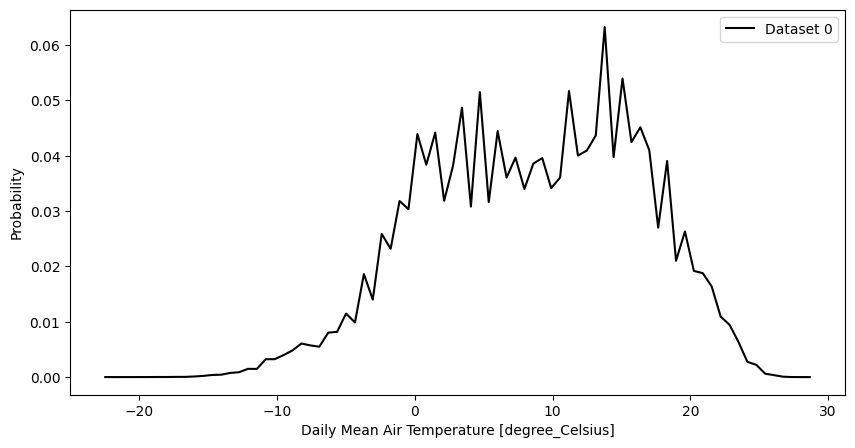
Probability distribution function
- Parameters:
dats ([
xarray.Dataset, List[xarray.DataArray]]) – The input dataset(s)var (str) – The variable names.
**kwargs – Any argument that can be passed to
matplotlib.pyplot.figureormatplotlib.pyplot.axes(). In particularylim=(0,15),size_inches=(20, 40)), oryscale='log'can be passed.range (tuple) – data Range, e.g.
range=(0, 10).nbins (int) – Number of bins.
nsamples (int) – Number of points sampled from the data..
Example
In [1]: %%time
   ...: import pyku
   ...: ds = pyku.resources.get_test_data('hyras_tas').compute()
   ...: ds.ana.pdf(var='tas', nbins=80)
   ...:
CPU times: user 321 ms, sys: 105 ms, total: 426 ms
Wall time: 422 ms
- pyku.analyse.pdf2D(ds, var=None, varx=None, vary=None, sample_size=100, ax=None, **kwargs)[source]#
2D distribution
- Parameters:
ds (
xarray.Dataset) – The input dataset.varx (str) – The variable on the x axis.
vary (str) – The variable on the y axis.
sample_size (int) – The sample size.
**kwargs – Any argument that can be passed to
matplotlib.pyplot.figure()ormatplotlib.pyplot.axes(). In particularylim=(0,15),size_inches=(20, 40)), oryscale='log'can be passed.
- pyku.analyse.percentile_map(ds_mod, ds_obs, var=None, percentile=0.5, crs=None, **kwargs)[source]#
Map of the nth percentile
Todo
Check if function is actually working
Create a documentation
I think the CRS should also work with
pyresample.geometry.AreaDefinition.
- Parameters:
ds_mod (
xarray.Dataset) – The first dataset.ds_obs (
xarray.Dataset) – The second dataset.var (str) – Variable name
percentile (float) – Percentile between 0 and 1
crs (
cartopy.crs.CRS) – Coordinate reference system
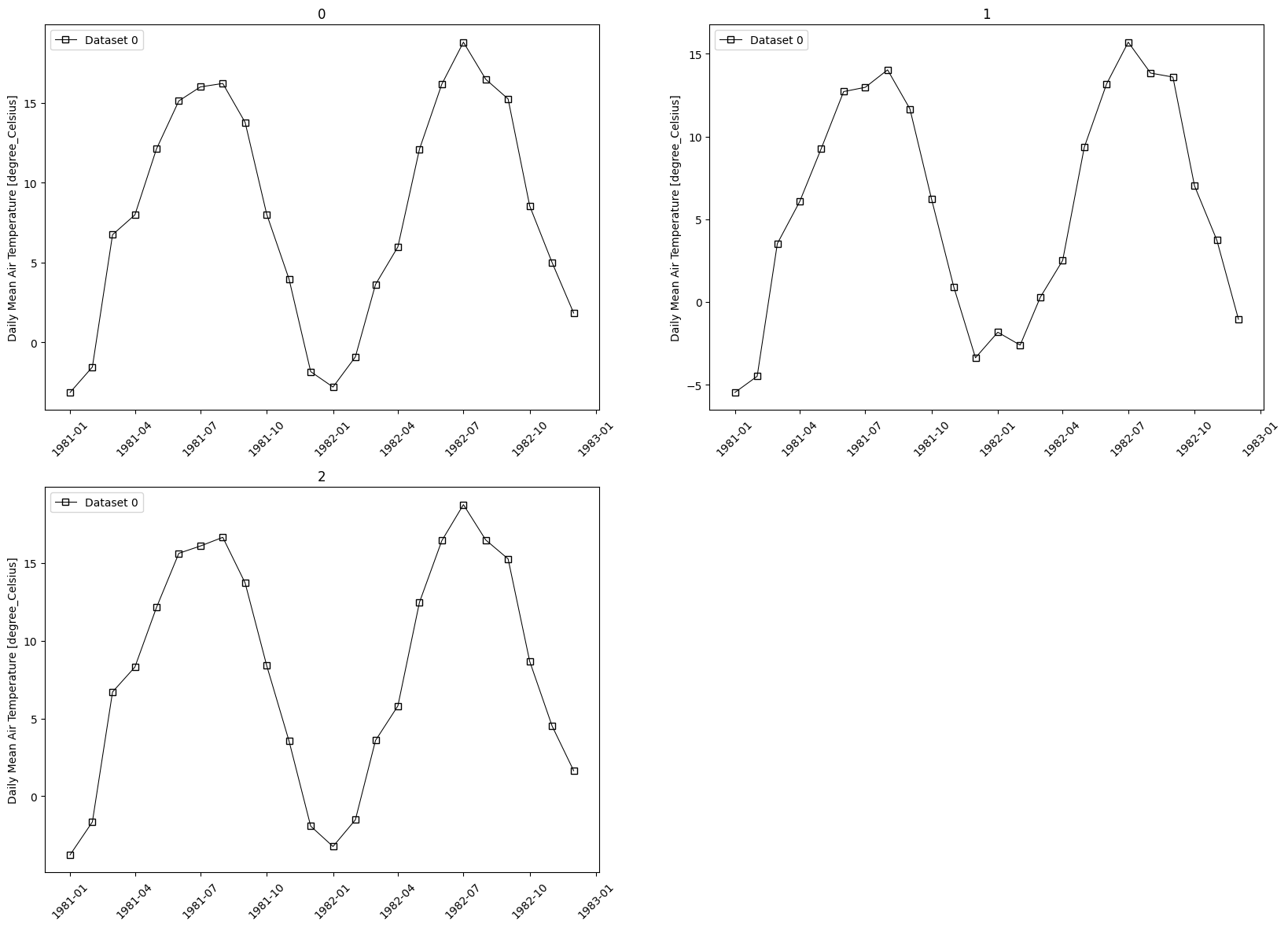
- pyku.analyse.regional_mean_vs_time(ds_mod, ds_obs=None, gdf=None, time_resolution='1MS', var=None, **kwargs)[source]#
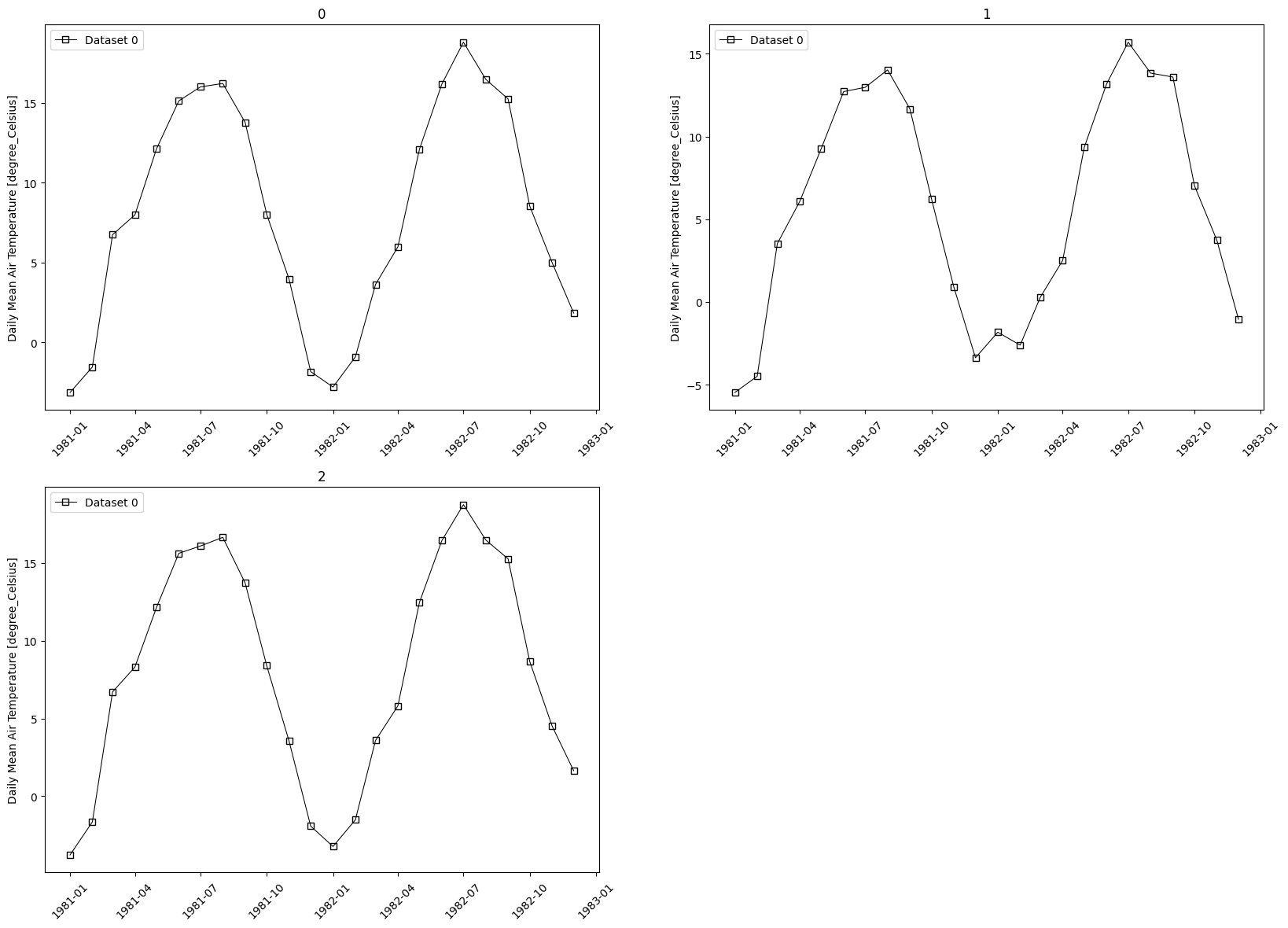
Time series per region
- Parameters:
ds_mod (
xarray.Dataset) – The first input dataset.ds_obs (
xarray.Dataset) – The second input dataset.gdf (
geopandas.GeoDataFrame) – The polygon data.var (str) – variable name
**kwargs – Any argument that can be passed to
matplotlib.pyplot.figure()ormatplotlib.pyplot.axes(). In particularylim=(0,15),size_inches=(20, 40)), oryscale='log'can be passed.
Examples
In [1]: %%time
   ...: import xarray as xr
   ...: import pyku
   ...: import pyku.analyse as analyse
   ...:
   ...: # Open and preprocess test data as needed
   ...: # ---------------------------------------
   ...:
   ...: ds = pyku.resources.get_test_data('hyras')
   ...:
   ...: # Get a subset ot the natrual areas or germany
   ...: # --------------------------------------------
   ...:
   ...: regions = (
   ...:     pyku.resources
   ...:     .get_geodataframe('natural_areas_of_germany')
   ...:     .head(3)
   ...: )
   ...:
   ...: ds.ana.regional_mean_vs_time(
   ...:     gdf=regions,
   ...:     time_resolution='1MS',
   ...:     var='tas'
   ...: )
   ...:
CPU times: user 10.4 s, sys: 1.94 s, total: 12.4 s
Wall time: 12.5 s
- pyku.analyse.regional_monthly_bias(ds_mod, ds_obs, gdf, area_def, var=None, **kwargs)[source]#
Monthly variability
Todo
Check if this function is working
Get the ipython code right
Check documentation is right. I think area_def can be passed as cartopy crs?
- Parameters:
ds_mod (
xarray.Dataset) – The first input dataset.ds_obs (
xarray.Dataset) – The second input dataset.gdf (
geopandas.GeoDataFrame) – The polygon data.var (str) – variable name
area_def (
pyresample.geometry.AreaDefinition) – Optional. The plot coordinate reference system.**kwargs – Any argument that can be passed to
matplotlib.pyplot.figure()ormatplotlib.pyplot.axes(). In particularylim=(0,15),size_inches=(20, 40)), oryscale='log'can be passed.
Examples
In [1]: %%time
   ...: import pyku
   ...:
   ...: # Open reference data and preprocess as needed
   ...: # --------------------------------------------
   ...:
   ...: ref = (
   ...:     pyku.resources.get_test_data('hyras')
   ...:     .pyku.to_cmor_units()
   ...:     .pyku.set_time_labels_from_time_bounds(how='lower')
   ...:     .pyku.project('HYR-LAEA-50')
   ...:     .sel(time='1981')
   ...:     .compute()
   ...: )
   ...:
   ...: # Open model data and preprocess as needed
   ...: # ----------------------------------------
   ...:
   ...: ds = (
   ...:     pyku.resources.get_test_data('model_data')
   ...:     .pyku.project('HYR-LAEA-50')
   ...:     .pyku.set_time_labels_from_time_bounds(how='lower')
   ...:     .sel(time='1981')
   ...:     .compute()
   ...: )
   ...:
   ...: gdf = (
   ...:     pyku.resources
   ...:     .get_geodataframe('natural_areas_of_germany')
   ...:     .loc[0:4]
   ...: )
   ...:
   ...: print('Polygons: ', gdf)
   ...:
   ...: # Calculate and plot
   ...: # ------------------
   ...:
   ...: # pyku.analyse.regional_monthly_bias(
   ...: #     ds, ref, gdf, area_def='HYR-LAEA-50', var='tas'
   ...: # )
   ...:
Polygons:       Shape_Leng  ...                                           geometry
0  1.676004e+06  ...  POLYGON ((3613725.5 5598209, 3613437 5597195, ...
1  8.566480e+05  ...  MULTIPOLYGON (((3614073 5273052, 3614476 52725...
2  1.096050e+06  ...  POLYGON ((3734247 5437391, 3734470 5437339, 37...
3  9.577557e+05  ...  POLYGON ((3288568.5 5633985.5, 3288857.25 5633...
4  1.457899e+06  ...  MULTIPOLYGON (((3794440.445 6030118.175, 37943...

[5 rows x 12 columns]
CPU times: user 1.1 s, sys: 397 ms, total: 1.5 s
Wall time: 1.26 s
- pyku.analyse.regional_monthly_variability(ds1, ds2, gdf=None, var=None, **kwargs)[source]#
Monthly variability
- Parameters:
ds1 (
xarray.Dataset) – The first dataset.ds2 (
xarray.Dataset) – The second dataset.gdf (
geopandas.GeoDataFrame) – The polygon data.var (str) – The variable name.
**kwargs – Any argument that can be passed to
matplotlib.pyplot.figure()ormatplotlib.pyplot.axes(). In particularylim=(0,15),size_inches=(20, 40)), oryscale='log'can be passed.
Examples
In [1]: import xarray as xr
   ...: import pyku
   ...: import pyku.analyse as analyse
   ...:
   ...: # Open and preprocess test data as needed
   ...: # ---------------------------------------
   ...:
   ...: ds1 = (
   ...:     pyku.resources.get_test_data('hyras')
   ...:     .pyku.to_cmor_varnames()
   ...:     .pyku.to_cmor_units()
   ...: )
   ...:
   ...: ds2 = pyku.resources.get_test_data('cordex_data')
   ...:
   ...: # Get a subset ot the natrual areas or germany
   ...: # --------------------------------------------
   ...:
   ...: regions = (
   ...:     pyku.resources
   ...:     .get_geodataframe('natural_areas_of_germany')
   ...:    .head(3)
   ...:  )
   ...:
   ...: # Calculate and plot
   ...: # ------------------
   ...:
   ...: analyse.regional_monthly_variability(
   ...:     ds1,
   ...:     ds2,
   ...:     gdf=regions,
   ...:     var='tas'
   ...: )
   ...:
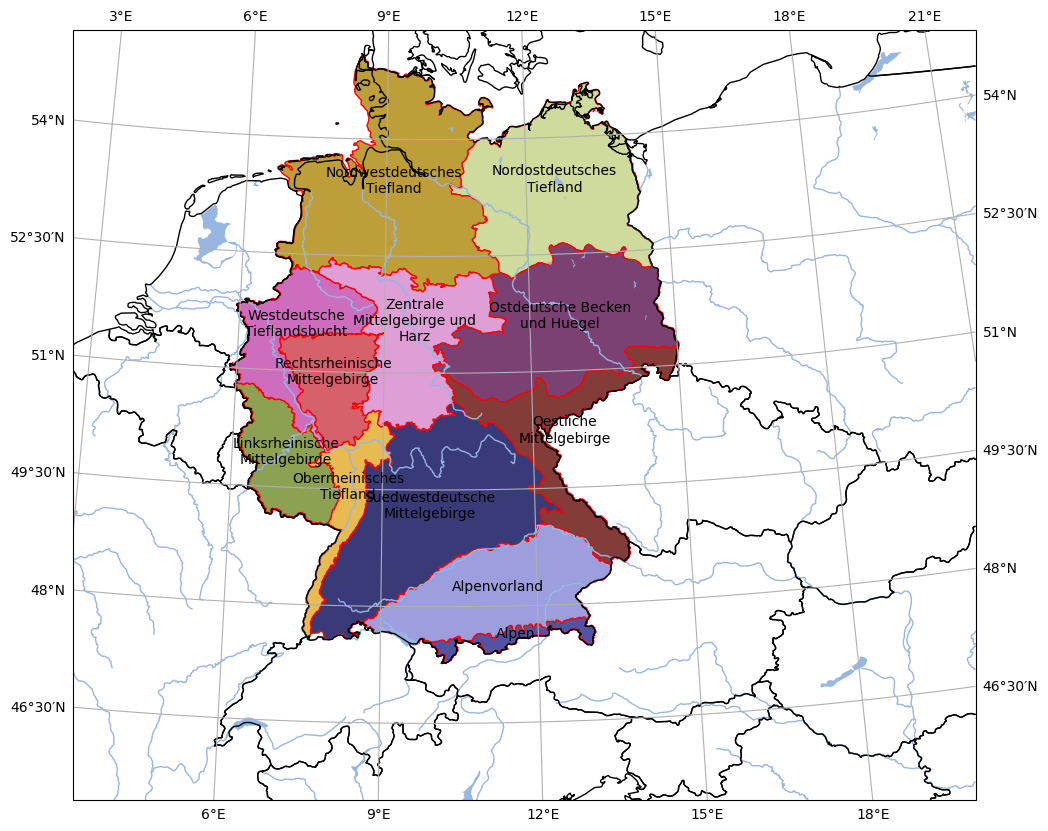
- pyku.analyse.regions(gdf, area_def, **kwargs)[source]#
Plot regions
- Parameters:
gdf (geopandas.GeoDataFrame) – Polygon data
area_def ([pyresample.AreaDefinition, string]) – Area definition
**kwargs – Any argument that can be passed to
matplotlib.ArtistIn particularsize_inchescan be passed.
Example
In [1]: import pyku
   ...: gdf = pyku.resources.get_geodataframe(
   ...:     'natural_areas_of_germany'
   ...: )
   ...: pyku.analyse.regions(gdf, area_def='HYR-LAEA-5')
   ...:
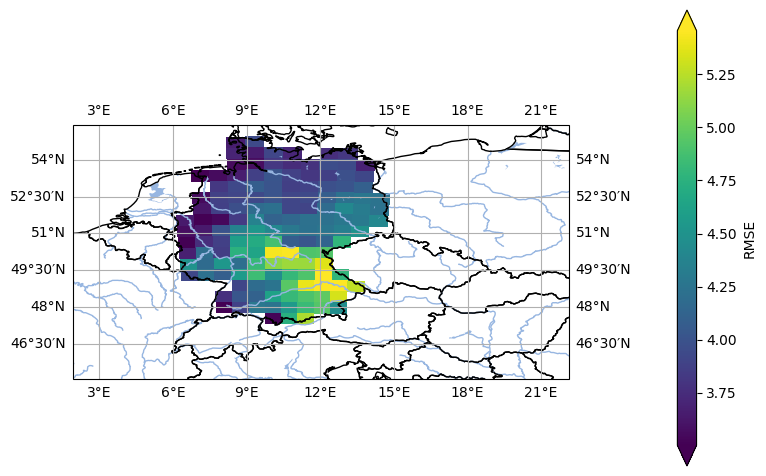
- pyku.analyse.rmse_map(*dats, ref, var=None, crs=None, ds_ref=None, **kwargs)[source]#
Map of the Root Mean Squared Error (RMSE)
- Parameters:
dats ([
xarray.Dataset, List[xarray.Dataset]]) – The input dataset(s).ref (
xarray.Dataset) – The reference dataset.var (str) – The variable name.
crs (
cartopy.crs.CRS,pyresample.geometry.AreaDefinition, str) – Optional. The coordinate reference system of the plot.**kwargs – Any argument that can be passed to
matplotlib.pyplot.pcolormesh(),matplotlib.pyplot.axes()matplotlib.pyplot.figure(), orcartopy.mpl.gridliner.gridlines(). For example,cmap,vmin,vmax, orsize_inchescan be passed.
Example
In [1]: %%time
   ...: import pyku
   ...:
   ...: # Open reference dataset and preprocess as needed
   ...: # -----------------------------------------------
   ...:
   ...: ref = pyku.resources.get_test_data('hyras')\
   ...:       .pyku.to_cmor_units()\
   ...:       .pyku.set_time_labels_from_time_bounds(how='lower')\
   ...:       .pyku.project('HYR-LAEA-50')\
   ...:       .sel(time='1981')\
   ...:       .load()
   ...:
   ...: # Open model dataset and preprocess as needed
   ...: # -------------------------------------------
   ...:
   ...: ds = pyku.resources.get_test_data('model_data')\
   ...:      .pyku.project('HYR-LAEA-50')\
   ...:      .pyku.set_time_labels_from_time_bounds(how='lower')\
   ...:      .sel(time='1981')\
   ...:      .load()
   ...:
   ...: # Calculate and plot
   ...: # ------------------
   ...:
   ...: ds.ana.rmse_map(ref=ref, var='tas')
   ...:
CPU times: user 1.13 s, sys: 453 ms, total: 1.58 s
Wall time: 1.35 s
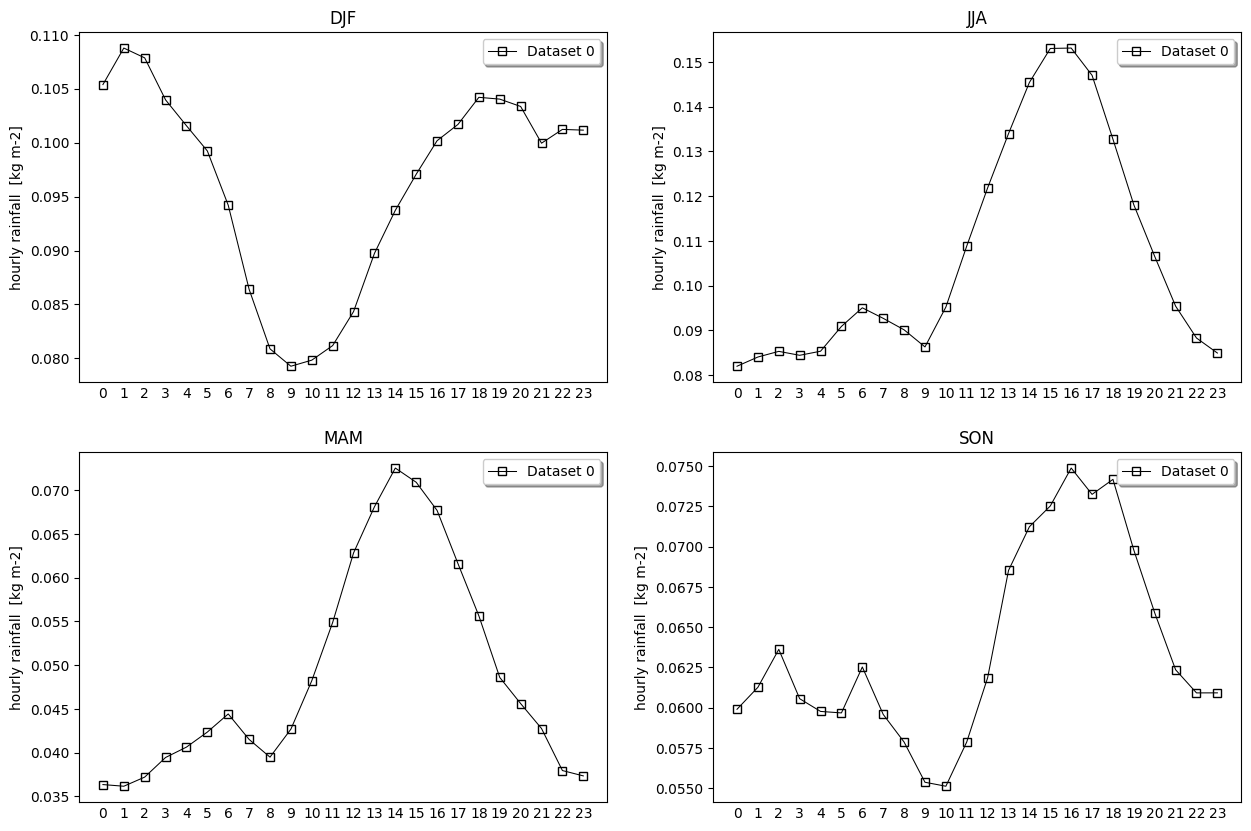
- pyku.analyse.seasonal_diurnal_cycle(dat1, dat2=None, var=None, ax=None, **kwargs)[source]#
Diurnal cycle for each seasons
- Parameters:
ds_mod (
xarray.Dataset) – Model datads_obs (
xarray.Dataset) – Reference datavar (str) – The variable name.
**kwargs – Any argument that can be passed to
matplotlib.pyplot.figure()ormatplotlib.pyplot.axes(). In particularylim=(0,15),size_inches=(20, 40)), oryscale='log'can be passed.
Examples
In [1]: %%time
   ...: import pyku
   ...: ds = pyku.resources.get_test_data('low-res-hourly-tas-data')
   ...: ds.ana.seasonal_diurnal_cycle(var='RR')
   ...:
CPU times: user 11.6 s, sys: 5.11 s, total: 16.7 s
Wall time: 34.3 s
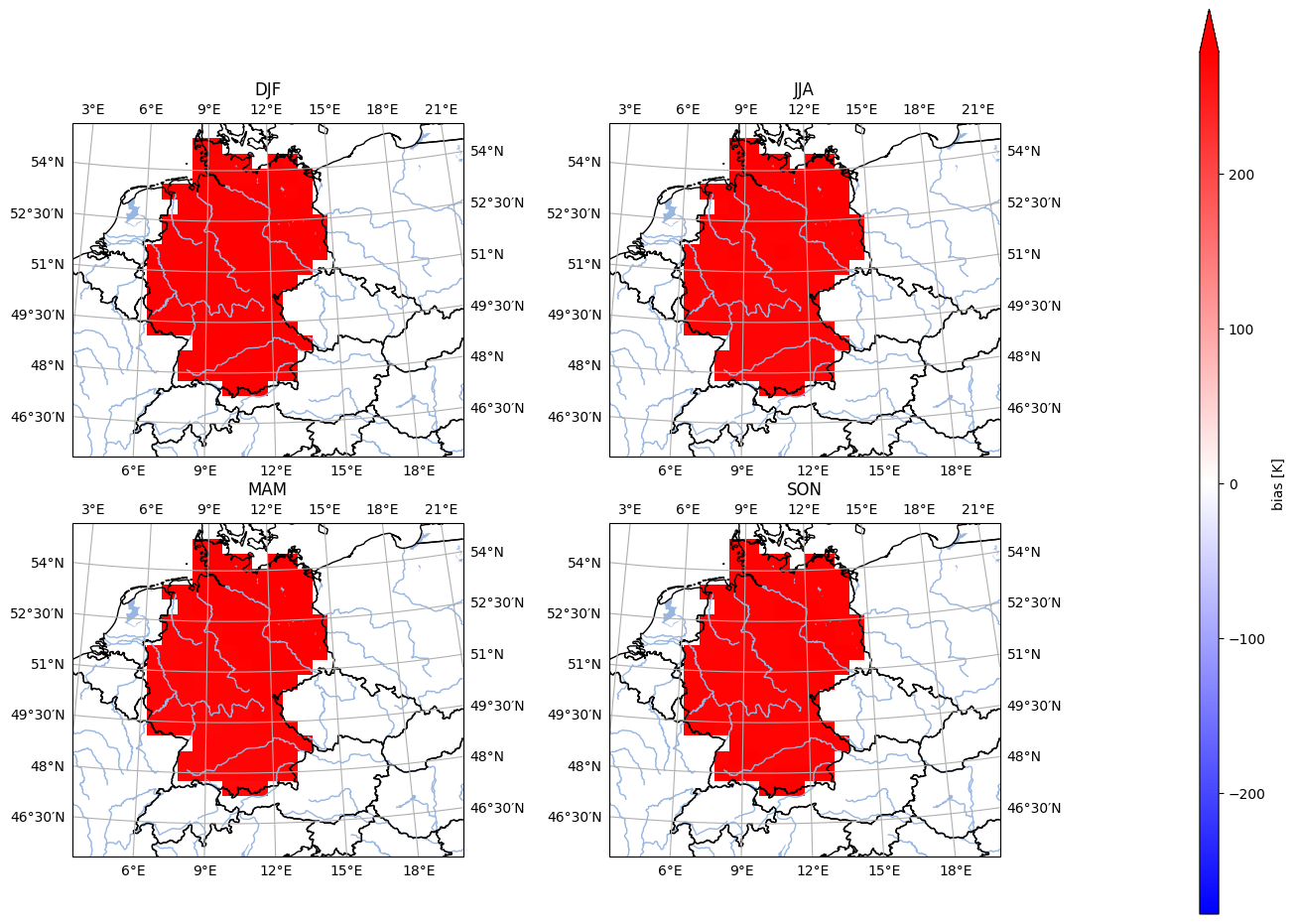
- pyku.analyse.seasonal_mean_bias_map(dats, ref, var=None, crs=None, **kwargs)[source]#
Map of the mean bias
- Parameters:
dats (
xarray.Dataset) – The input model datasetref (
xarray.Dataset) – The Reference/Observation datavar (str) – The variable name
crs (
cartopy.crs.CRS,pyresample.geometry.AreaDefinition, str) – Optional. The plot coordinate reference system.**kwargs – Any argument that can be passed to
matplotlib.pyplot.pcolormesh(),matplotlib.pyplot.axes()matplotlib.pyplot.figure(), orcartopy.mpl.gridliner.gridlines(). For example,cmap,vmin,vmax, orsize_inchescan be passed.
Notes
If an argument is passed which is not recognized, no error message is thrown and the argument is ignored.
Example
In [1]: import pyku
   ...:
   ...: # Open reference dataset and preprocess as needed
   ...: # -----------------------------------------------
   ...:
   ...: ref = (
   ...:     pyku.resources.get_test_data('hyras')
   ...:     .pyku.project('HYR-LAEA-50')
   ...:     .sel(time='1981')
   ...:     .compute()
   ...: )
   ...:
   ...: # Open model dataset and preprocess as needed
   ...: # -------------------------------------------
   ...:
   ...: ds = (
   ...:     pyku.resources.get_test_data('model_data')
   ...:     .pyku.project('HYR-LAEA-50')
   ...:     .sel(time='1981')
   ...:     .compute()
   ...: )
   ...:
   ...: # Calculate and plot
   ...: # ------------------
   ...:
   ...: ds.ana.seasonal_mean_bias_map(
   ...:     ref=ref,
   ...:     var='tas',
   ...:     crs='HYR-LAEA-50'
   ...: )
   ...:
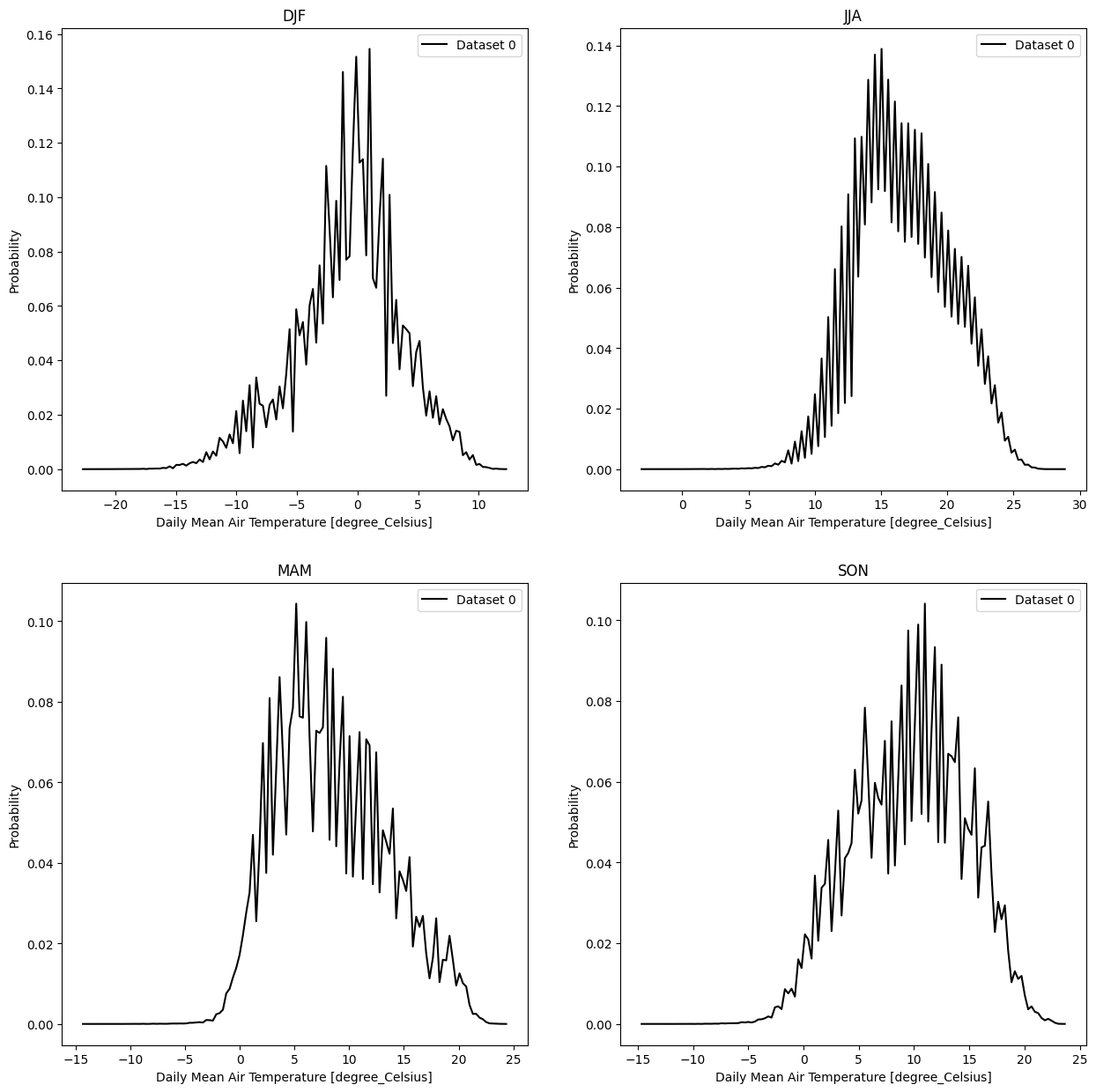
- pyku.analyse.seasonal_pdf(*dats, var=None, **kwargs)[source]#
Probability distribution function for each season
- Parameters:
dats (
xarray.Dataset, List[xarray.Dataset]]) – The input dataset(s).var (str) – The variable name.
**kwargs – Any argument that can be passed to
matplotlib.pyplot.figure()ormatplotlib.pyplot.axes(). In particularylim=(0,15),size_inches=(20, 40)), oryscale='log'can be passed.
Example
In [1]: import pyku
   ...: ds = pyku.resources.get_test_data('hyras_tas')
   ...: ds.ana.seasonal_pdf(var='tas')
   ...:
- pyku.analyse.summary_table(ds_mod, ds_obs, **kwargs)[source]#
Summary in table form
- Parameters:
ds_mod (
xarray.Dataset) – Model dataset.ds_obs (
xarray.Dataset) – Reference dataset.
- Returns:
reStructuredText table
- Return type:
str
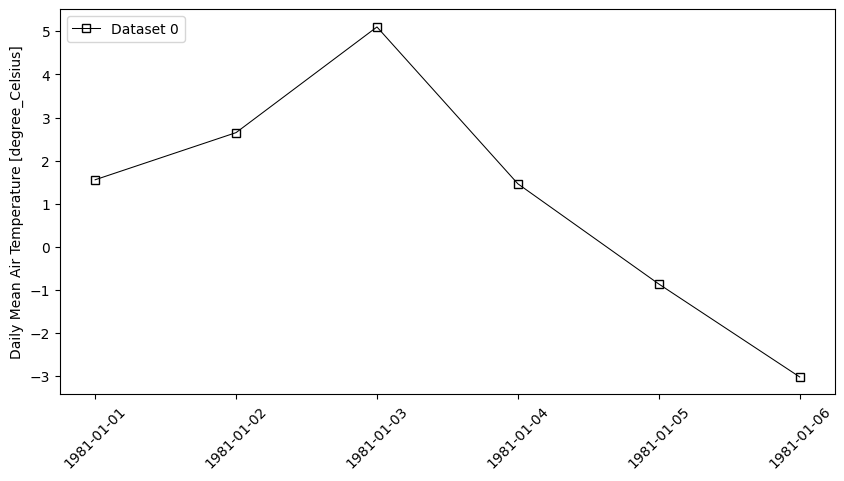
- pyku.analyse.time_serie(*dats, var=None, ax=None, **kwargs)[source]#
Time serie. The data are averaged over y/x and plotting against time
- Parameters:
*dats (
xarray.Dataset, List[xarray.Dataset]) – The input dataset(s).var (str) – The variable name.
ax (
matplotlib.pyplot.axes) – Optional. Matplotlib pyplot axis.**kwargs – Any argument that can be passed to
matplotlib.pyplot.figure()ormatplotlib.pyplot.axes(). In particularylim=(0,15),size_inches=(20, 40)), oryscale='log'can be passed.
Example
In [1]: pyku
   ...: ds = pyku.resources.get_test_data('hyras_tas')\
   ...: .isel(time=[0,1,2,3,4,5])
   ...: ds.ana.time_serie(var='tas')
   ...:
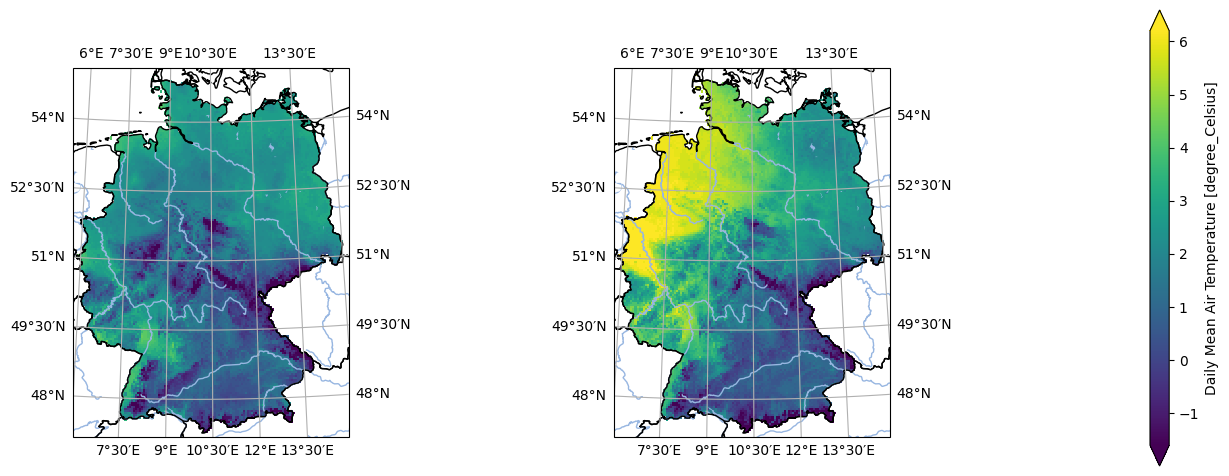
- pyku.analyse.two_maps(dat1, dat2, var=None, crs=None, **kwargs)[source]#
Plot two maps side by side
- Parameters:
dat1 (
xarray.Dataset) – The first dataset.dat2 (
xarray.Dataset) – The second dataset.var (str) – The name of the variable.
crs (Union[
cartopy.crs.CRS,pyresample.geometry.AreaDefinition, str]) – Coordonate reference system. A pyku pre-defined projection identifier can be passed with a string.**kwargs – Any argument that can be passed to
matplotlib.pyplot.pcolormesh(),matplotlib.pyplot.axes()matplotlib.pyplot.figure(), orcartopy.mpl.geoaxes.GeoAxes.gridlines(). For example,cmap,vmin,vmax, orsize_inchescan be passed.
Notes
If an argument is passed which is not recognized, no error message is thrown and the argument is ignored.
Example
In [1]: %%time
   ...: import pyku
   ...:
   ...: ds = pyku.resources.get_test_data('small_tas_dataset')
   ...:
   ...: pyku.analyse.two_maps(
   ...:     ds.isel(time=0),
   ...:     ds.isel(time=1),
   ...:     rows=1,
   ...:     cols=2,
   ...:     var='tas',
   ...:     crs='HYR-GER-LAEA-5',
   ...: )
   ...:
CPU times: user 179 ms, sys: 90.8 ms, total: 270 ms
Wall time: 267 ms
- pyku.analyse.var_vs_year(dat_mod, dat_obs, var=None, **kwargs)[source]#
Variability vs year
Todo
Function looks very outdated and needs to be reworked
- Parameters:
ds_mod (
xarray.Dataset) – The first dataset.ds_obs (
xarray.Dataset) – The second dataset.var (str) – Variable name
**kwargs – Any argument that can be passed to
matplotlib.pyplot.figure()ormatplotlib.pyplot.axes(). In particularylim=(0,15),size_inches=(20, 40)), oryscale='log'can be passed.